Field Day 2026
June 27 - 28 , 2026
Prologue:
The most anticipated event on the club calendar is the annual Amateur Radio Relay League Field Day event. This event is always held on the last full weekend of June. This year's event is special in that the United States of America is celebrating its 250th year since the signing of the Declaration of Independence. All radio amateurs in North and South America (Region 2) look forward to taking to the field and setting up their radios and operating in less than optimal conditions. This demonstrates their capability to operate if and when an actual emergency or disaster occurs. This is always a fun time to get together with friends who share this great hobby and enjoy the camaraderie.
 The weather in the Mid-South is always hot and sticky this time of year, and this year was no exception. Pop-up thunderstorms were expected with temperatures in the high 80's to low 90's. As has been the case for the last 17 years, the venue for the club's Field Day operation is "The Shop" at Glenn N4MJ's QTH in South Fulton, Tennessee. This well-appointed facility is blessed with open spaces for setting up tables for radios, a good air conditioner, refrigerator, coffee maker, and a bathroom. The club is grateful to have such a nice place to hold this event.
Last year, the Reelfoot Amateur Radio Club decided to do away with generators and 100 watt radios and up the ante to battery-operated, low power (5 watt) QRP operation. This allowed us to greatly simplify our radios and supporting equipment and use just batteries, instead of a gasoline powered generator. The results were good with over 600 QSO's made and we placed 3rd overall in class 2AB (QRP battery) in the USA. We again decided to do this again and see if we could improve our scores and possible move up in the standings. The lower power puts us at a disadvantage against higher powered stations, but it gives us a power multiplier of 5. This effectively balances out that disadvantage. Normally, QSO's made using CW or digital modes would be for 2 points when using 100 watts; making them with 5 watts would make them effectively 10 point QSO's. Nice !
Setup: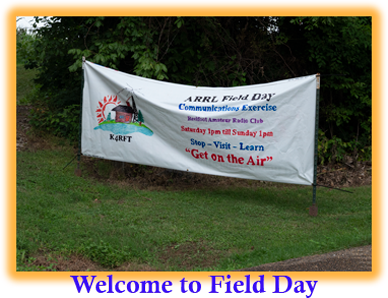
As is the usual case, setup of radios began on Thursday evening prior to the Field Day event. Pizzas were again provided by our hostess Linda and they really hit the spot. In a little over an hour, all radios were up and running. There was some tweaking that needed to be done when the event started.
The Get On The Air (GOTA) station was provided by our club president Patrick KO4HEX with his Yaesu FT-817 along with his newly-acquired LDG tuner. This radio is capable of running all modes and power was provided by a 100Ah Lithium battery. This station normally attracts our youth operators and low-time amateurs who just want to make a contact or two. It runs with Glenn's callsign N4MJ.
For the class designation of 2A, the two HF stations consisted of (HF1) Jamie WB4YDL's Elecraft KX3 (with built-in tuner) and (HF2) Phil N4PWG's Icom IC-705 (also with built-in tuner). The HF1 station is powered by a 50 Ah Lithium battery.
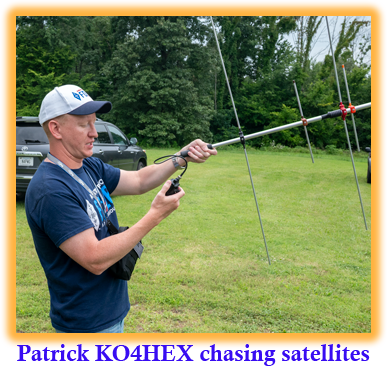
 The "free" VHF station this year again consisted of Jamie WB4YDL's Yaesu FT-818 which has all-mode capability up to the 70 cm. band. This station also incorporates an AirSpy K2 SDR receiver used for satellite communication. Last year, satellite communication was really tough with QRP level power, and the number of available "birds" was limiting. Luckily, we were able to make that important QSO for a 100 point bonus. Power for this station and the HF2 station was with another 50 Ah Lithium battery.
All stations are capable of any mode, digital or analog. Sound card interfacing was generally done via the very capable DigiRig interface except for the IC-705 which is incorporated internally. The VHF station used the same hardware as last year, but this year, the new SkyRoof satellite software was incorporated. Jamie WB4YDL has been experimenting with this software since Alex VE3VEA came out with it in the fall of last year. Before, several pieces of software had to be used to receive and simultaneously control the uplink and downlink Doppler shifting as well as point the satellite antenna array at the "bird". Now this new software can do all this in one package. This makes it much easier to configure and handle ! The satellite antennas (simple Arrow yagis for 2M and 70 cm) were mounted on a PVC crossboom using a Yaesu G-5500 alt-az rotator system. With Solar Cycle 25 at near peak, it was hoped that 6 meters would be a productive band. 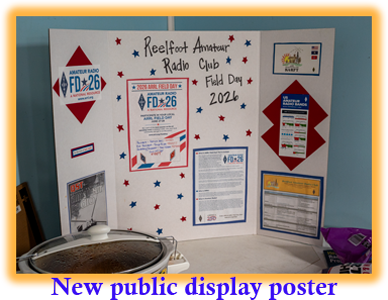
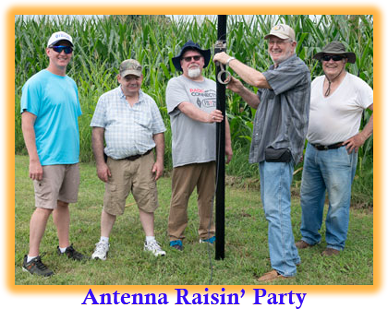
The following afternoon, we met to raise the antennas that were going to be used. For HF, this consisted of the TN-07 inverted-L antenna for the Elecraft KX3 station and a 80M end-fed half-wave antenna configured as an inverted-L and a Mosley TA-32 Mini yagi for the HF2 Icom IC-705 station. The inverted-L antenna was mounted on a 50 foot SpiderMast at the 40 foot level ! We also had another 40M OCD (off-center fed dipole) that would be attached to the GOTA station. These antennas are very simple antennas and took little time to deploy. The 6M antenna would also be a small yagi on a mast. 2M activity would borrow the satellite Arrow yagi for such things as Winlink traffic.
The Operation:
Saturday morning arrived and the weather was reasonable but with the threat of rain later in the day. The solar panels (a Bioenno 30 watt) were set up to feed and charge a 30 Ah battery pack and hooked to the Elecraft KX3 for the initial CW contacts that Glenn would make on this alternate power source. After a great lunch with sub sandwiches and a great education session on making a cheap dipole antenna, given by Phil N4PWG, it was time to get ready to start the event. 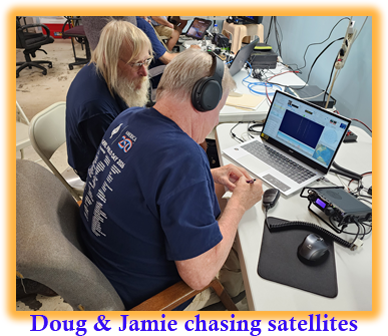 At the appointed time of 1 PM, the event started and the bands erupted. Thankfully, there was no clap of thunder as was the case last year ! Glenn N4MJ set up for CW operation on 20 meters and in about 2 minutes, he had the required 5 QSO's on alternate power in the log. When he was told to just keep going, he said "Cool !" ... and that he did.
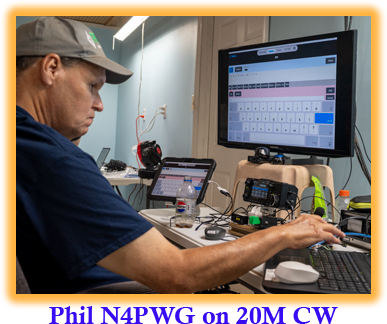
Phil N4PWG had the more complex station as he was running a CW reader through a MacOS computer and interfacing (and interlacing) the logging with a Windows 10 laptop that was networked to the other HF station's computer !! Taking lessons from last year, CW was easily outpacing the digital mode efforts, at least on the two HF stations.
Jamie WB4YDL started operation on the VHF station by first checking into the local Winlink Packet node and made quick work of the 100 point NTS message bonus. Over 10 messages were received from all over the continent, and shortly, return messages were sent. Winlink was checked intermittently throughout the event. Also, Jamie set up an APRS object of our Field Day site in hopes of attracting visitors. Both Phil and Jamie copied the W1AW Field Day bulletin and a NTS Radiogram was sent to the Tennessee Section Manager, David KM4NYI.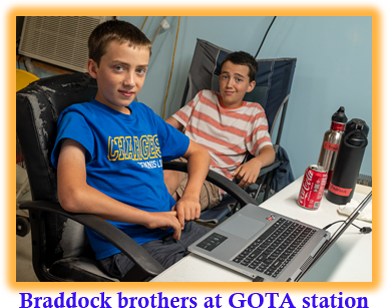
The GOTA station was by and large operated by Patrick KO4HEX and the Braddock "Band of Brothers" ! Brothers Alistair, Calvin, and Daniel all made contacts and gave the club needed bonus points for youth participation. Digital FT8 contacts were the rule on this station this year.
Most of the contacts on the HF stations were made on 20M and 40M, as was the case last year. But this year, with some interesting solar weather occurring, 10M and especially 6M started to show up.
Excellent burgers and 'dogs were grilled by our grill master Noel KJ4UNX and Harold KM4FTM brought a beautiful 3 layer chocolate cake made with imported Italian chocolate ! Wow !! Also, he made two racks of homemade cinnamon rolls ! In addition, Harold also brought barbecue pulled pork and baby back ribs ! Nobody came and left hungry !
 Several attempts were made at a satellite contact by Jamie WB4YDL and finally, with the Russian RS-44 "bird" near the horizon, a QSO was made on this linear transponder with a station in Alabama. This was good for another 100 point bonus ! Interestingly, this was a similar situation as last year and it is speculated that extra gain was experienced near the horizon - enough to snag the contact.
The night shift was occupied by Phil N4PWG, Patrick KO4HEX, and Michael AK4VU. They were all able to catch power naps ! The air conditioning definitely helped with the comfort. No radio over-heating was noticed this year, but some used auxiliary fans to help air flow and prevent any thermal issues.
This year, we had a total of 11 operators with 3 youth participants. Also present this year was Obion County Sheriff Karl Jackson, who represented our elected official visitor. Additionally, we were pleased to be visited by Doug Weaton KC3AQP representing Weakley County EMA and hailing from Palmersville, Tennessee.
Finally, at 1 PM Sunday, the operations ceased and another Field Day was in the books !
The Results:
So, as the solar cycle is approaching its peak and activity on the bands gets hot, how did this translate for this Field Day ? Here are the line scores :Score Summary:
| CW | Digital | Phone |
Total | |
|---|---|---|---|---|
| Total QSO's | 275 |
421 |
1 |
697 |
Band / Mode QSO Breakdown:
| CW | Digital | Phone | Total | |
|---|---|---|---|---|
| 80M | 11 |
65 |
0 |
76 |
| 40M | 123 |
0 |
0 |
123 |
| 20M | 95 |
46 |
0 |
141 |
| 15M | 39 |
1 |
0 |
40 |
| 10M | 7 |
28 |
0 |
35 |
| 6M | 0 |
96 |
0 |
96 |
| SAT | 0 |
0 |
1 |
1 |
| GOTA | 0 |
185 |
0 |
185 |
| TOTAL | 275 |
421 |
1 |
697 |
The bonus point total this year was 2535 points which was up from last year. This is thanks to the addition of the Media Publicity bonus and a substantial increase of GOTA bonus points.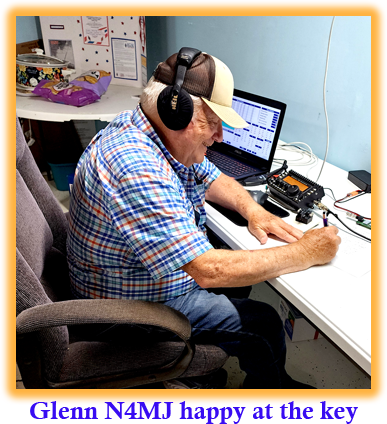
The total QSO score after the power multiplier (x5) came out to 6965 points, a nice 525 point improvement from last year ! Largely this was due to increased CW contacts as well as a great GOTA digital contact score. Also, the VHF station set a club record of 96 QSO's made on 6M, beating the previous record of 76 QSO's way back in 2017.
There were 35 more CW contacts made and 70 more digital contacts made in comparison to Field Day last year. Now that we have two years under the belt as 2AB, this is an "apples to apples" comparison. A satellite contact was made under very difficult conditions with the Russian RS-44 linear transponder satellite using the new SkyRoof software.
105 more QSO's were made this year operating QRP - guess the challenge was accepted ! The 240 more bonus points achieved and the power multiplier of 5x made a difference. The total submitted score was 9500 points for Reelfoot Amateur Radio Club in the class 2AB category. This is a new club Field Day record beating last year's previous record !!
The decision was made this year to challenge our already seasoned operators to do it again - perform even better. With low-power radios, and a little more software, as a club, this Field Day effort was even more spectacular than last year!
Epilogue:
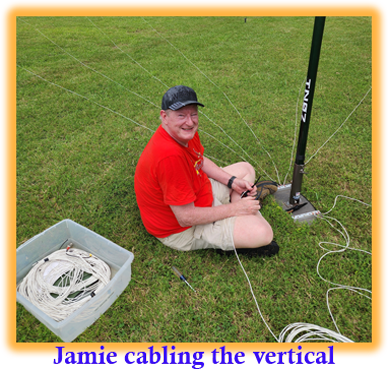
Once again, the crew at Reelfoot Amateur Radio Club showed out ! The operation was run smoothly with two hour setup and one hour break down times. Issues that came up were simple to fix, such as old cold solder joints on a cable feeding the TN-07 vertical, and a Powerpole connector that slipped off its wires. A Wago clamp to PowerPole adapter provided by Jamie WB4YDL's go-kit in his truck, provided the easy fix for the latter item. 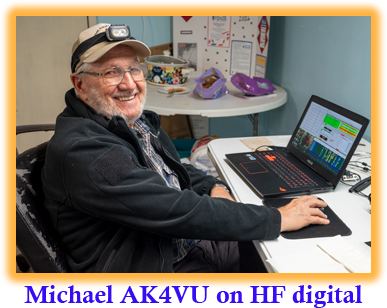
Photography credits go to Jamie WB4YDL, and Patrick KO4HEX - co-chairmen of Field Day. This article was not imagined by AI ! It was written solely by Jamie WB4YDL and his Muse.
The Shop at the QTH of Glenn N4MJ was once again the perfect Field Day location and the club members owe many thanks to Glenn and XYL Linda for a wonderful experience. Thanks also go to our XYL's who kept us fed and hydrated. The full Field Day results are published in the December issue of QST.
Soapbox:
Glenn N4MJ :
73 de n4mj//glenn
See you on Field Day 2026 !
When all else fails ... Amateur Radio.